
The Grandparent's Edge: How to Stay Deeply Influential in Your Grandchildren's Lives
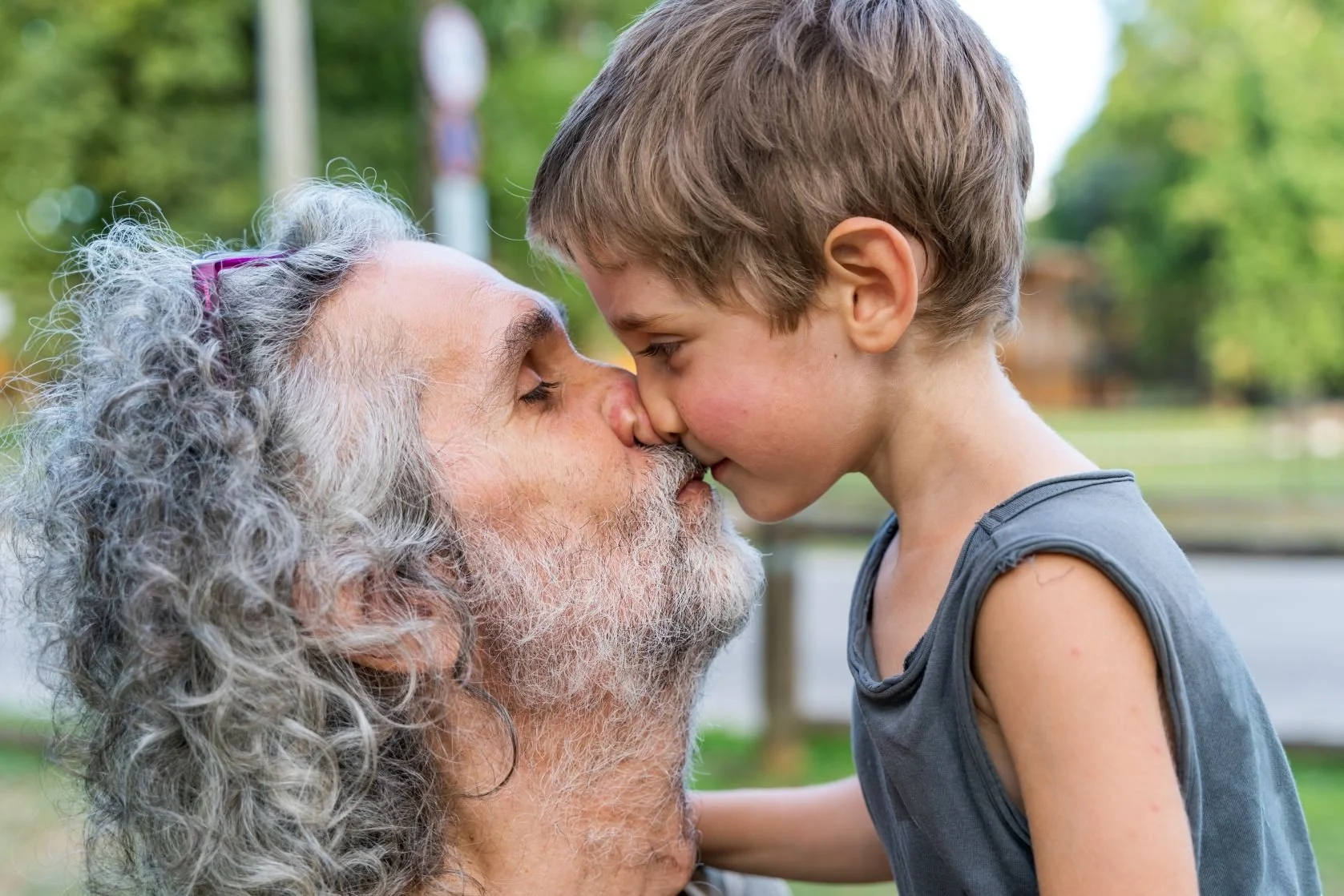
You've raised children, weathered life's biggest plot twists, and built a store of wisdom that no parenting app can replicate. So why can it feel like the rules have changed, and no one gave you the memo?
If you've ever felt corrected about screen time, gently redirected on food choices, or quietly side-stepped on sleep routines — welcome to one of the most common (and least talked about) challenges facing grandparents today.
This isn't a failure of love. It's a developmental transition. And like all the great transitions in your story, it may carry unexpected upsides.
You're not imagining it: Parenting has changed
Gentle parenting, responsive feeding, co-sleeping, screen-free zones, sugar limits, ‘big feelings’ language — today's parents are navigating a parenting landscape shaped by decades of new research, social media, and a culture that would seem to be leaving them in more anxiety to get it right than other generations before them.
Since the 1970s, the dominant shift in developmental psychology has been away from the extremes — away from the very strict, authoritarian approach on one end and the very permissive, boundary-free approach on the other — toward what researchers call authoritative parenting of warmth with clear expectations, and empathy with structure (Rothenberg et al., 2021). That's not as different from good grandparenting as it might first appear.
What has changed is the vocabulary, the intensity, and the visibility. Parents today face an enormous amount of information — and an enormous amount of judgement. Some of what can feel like correction from your adult-children is less about you and more about the pressure they're under to do everything ‘right.’
The deeper thing happening: a life transition, not a role loss
Here's the psychological reframe that changes everything.
Becoming a grandparent isn't just a new relationship; it's one of the most significant developmental transitions of later life. Research published in 2023 described the transition to grandparenthood as one of the most meaningful role-shifts available in midlife and older age, linked to renewed identity, purpose, and life satisfaction — particularly for grandparents who remain actively engaged while maintaining their own independence (Danielsbacka et al., 2022).
And the psychological stakes are high in the other direction too. Erik Erikson — the theorist behind the famous ‘stages of life’ — proposed that the central challenge of midlife and later life is what he called generativity: the deep human drive to nurture, guide, and leave something of value for the generation coming behind you (Erikson, 1982). Erikson proposed that adults are driven by a deep need to contribute to future generations — what he called generativity (Erikson et al., 1986). In later life, this often finds expression through grandparenting, and a grandparent's particular gift of wisdom, continuity, and perspective (Erikson et al., 1986), that parents in the thick of daily life, may struggle to offer in quite the same way
Although if you’re feeling sidelined, that's not just frustrating. It touches something fundamental about meaning and legacy in the second half of life. And a growing body of literature in this space would seem to support that: generativity in older people is consistently linked to greater life satisfaction, positive mental health, and stronger functional capacity (Nonaka et al., 2023; Villar et al., 2021), with more recent evidence suggesting it may even play a protective role against cognitive decline (Bhattacharyya & Molinari, 2024)."
What your grandchildren actually need from you — and it's not a parenting clone
Here is something the research is very clear on: grandparents are not meant to be interchangeable with parents. The grandparent relationship is distinct; and that distinctiveness is precisely what makes it protective.
A 2024 study tracking thousands of children found that a close, supportive grandparent relationship in early childhood was significantly associated with better emotional wellbeing, resilience, and lower anxiety in young adulthood (Stephenson & Carstensen, 2025). What children carry forward isn't perfect rule-following; it's the feeling of being unconditionally known, loved, and delighted in by someone who has nothing to prove.
Grandparents bring something that time-poor parents simply cannot always offer: a slower pace, a longer view, and the lived knowledge that most things — even the really hard things eventually come right. That's a legacy.
Research on intergenerational grandparenting also shows that a grandparent's warmth, encouragement, and consistent presence is among the most significant protective factors for children's mental health, more so than the specific parenting approach used (Liang et al., 2025).
The art of being influential without being intrusive
So how do you stay deeply present and genuinely influential, while navigating an environment where the parenting rules have shifted? Here are some approaches grounded in research and consistent with the kind of wisdom that only comes from having lived:
Lead with curiosity, not authority. Ask your adult children what's working for them, rather than offering unsolicited advice. For example, "Tell me more about why you're doing it that way" is a powerful door-opener. Genuinely curious grandparents are invited in. Defensive ones are managed from a distance.
Find your non-negotiables — and let the rest go. You don't have to agree with every parenting choice. But identifying the two or three things that truly matter to you (safety, kindness, connection) and releasing the rest is both psychologically freeing and relationship-protecting. Research on intergenerational co-parenting consistently shows that alignment on values between grandparents and their adult-children — not necessarily practices — is what supports children's emotional security (Xu et al., 2024).
Offer what only you can offer. Stories. History. Slow time. Your grandchildren may not remember whether you enforced the no-screen rule correctly. They may remember the afternoon you told them about your childhood, the meal you made together, the time you sat with them when they were sad and didn't try to fix it. That's irreplaceable.
Use "their language" when you can. If your grandchild is having a ‘big feelings moment’ and you acknowledge it in the way their parents do, you're not capitulating — you're building a bridge. Children feel safe when the important people in their lives speak a common emotional language.
Have the conversation with your adult children — privately, warmly. The tension around parenting differences often grows in silence. A low-stakes, non-defensive conversation: e.g., "I'd love to understand your approach better so I can support it when I'm with them" — opens the door to both being heard and being trusted with more.
Take care of yourself, too. Research consistently shows that grandparents who maintain their own social connections, interests, and independence — rather than defining themselves entirely through their grandparent role — not only have better wellbeing but are also more sustainably present for their grandchildren (Danielsbacka et al., 2022).
The upside: what this chapter may really be offering you
There's a particular kind of growth available in this chapter of life that may not be available earlier. You have context. You've watched things unfold over decades. You know that the parenting panic of one generation becomes the nostalgic fondness of the next. You’re likely to understand that children are more resilient — and more shaped by love — than any set of rules.
Research shows that becoming a grandparent is associated with higher life satisfaction and, when grandparents are actively involved, a meaningful deepening of their sense of purpose — especially when they experience that involvement as chosen and generative rather than obligatory (Chereches et al., 2025).
The discomfort of navigating different parenting styles is real. But it is also an invitation — to grow in flexibility, to deepen relationships with your adult children, to discover who you are as a grandparent rather than simply repeating who you were as a parent. That's a potentially rich chapter.
When it's more than a parenting disagreement
Sometimes what surfaces in the grandparenting chapter isn't just about screen rules or sugar. Sometimes it touches older wounds; feelings of being undervalued, grief about ageing, tension in the family system that goes back further than the grandchildren.
If you're finding that this new chapter is bringing up something bigger — a question of identity, a sense of loss, a feeling that your role in the family has quietly shrunk — that's worth exploring with someone who can help you make sense of it.
At Upside Stories, we work with adults in midlife and later life to navigate exactly these kinds of transitions: exploring ways to rewrite the story you've been living by and what a chapter that feels meaningful and yours could look like.
Ready to explore your next chapter?
If grandparenting, family dynamics, or finding meaning in this chapter of life is something you'd like to explore more, through online psychological therapy with an experienced clinical psychologist, Upside Stories is here for you. Start with a free 20-minute consultation; no referral needed.
References & reading
Buchanan, A., & Rotkirch, A. (2018). Twenty-first century grandparents: Global perspectives on changing roles and consequences. Contemporary Social Science, 13(2), 131–144. https://doi.org/10.1080/21582041.2018.1467034
Chereches, F. S., Ballhausen, N., Brehmer, Y., & Olaru, G. (2025). Sense of purpose and meaning in life during the transition to grandparenthood. Journal of Personality, 93(1). https://doi.org/10.1177/08902070241257667
Danielsbacka, M., Křenková, L., & Tanskanen, A. O. (2022). Grandparenting, health, and well-being: A systematic literature review. European Journal of Ageing, 19(3), 341–368. https://doi.org/10.1007/s10433-021-00674-y
Erikson, E. H. (1982). The life cycle completed. Norton.
Erikson, E. H., Erikson, J. M., & Kivnick, H. Q. (1986). Vital involvement in old age. Norton.
Liang, J., Li, Y., & Chen, X. (2025). Associations of grandparenting dimensions/styles with mental health in children and adolescents: A systematic review and meta-analysis. Behavioral Sciences, 15(2), 180. https://doi.org/10.3390/bs15020180
Nonaka, K., Murayama, H., Murayama, Y., Murayama, S., Kuraoka, M., Nemoto, Y., Kobayashi, E., & Fujiwara, Y. (2023). The impact of generativity on maintaining higher-level functional capacity of older adults: A longitudinal study in Japan. International Journal of Environmental Research and Public Health, 20(11), 6015. https://doi.org/10.3390/ijerph20116015
Rothenberg W. A., Lansford J. E., Bornstein M. H., Uribe Tirado L. M., Yotanyamaneewong S., Alampay L. P., Al-Hassan S. M., … … Steinberg L. (2021). Cross-cultural associations of four parenting behaviors with child flourishing: Examining cultural specificity and commonality. Child Development, 92(6), e1138–e1153. https://doi.org/10.1111/cdev.13520
Sari, E. (2023). Multigenerational health perspectives: The role of grandparents' influence in grandchildren's wellbeing. International Journal of Public Health, 68.https://doi.org/10.3389/ijph.2023.1606292
Stephenson, J. M., & Carstensen, L. L. (2025) Grandparent support during childhood is associated with emotional wellbeing in emerging adulthood. Frontiers in Psychology 16:1680383. https://doi: 10.3389/fpsyg.2025.1680383
Villar, F., Serrat, R., Pratt, M. W., & Stukas, A. A. (2021). Older age as a time to contribute: A scoping review of generativity in later life. Ageing & Society. https://doi.org/10.1017/S0144686X21001379
Xu, J., Cheah, C. S. L., & Wang, M. (2024). Intergenerational co-parenting and child development outcomes: A systematic review. Journal of Family Theory & Review, 16(4). https://doi.org/10.1111/jftr.12594
