
AI Companions for Older People: What the Research Says, and What We Should Be Asking
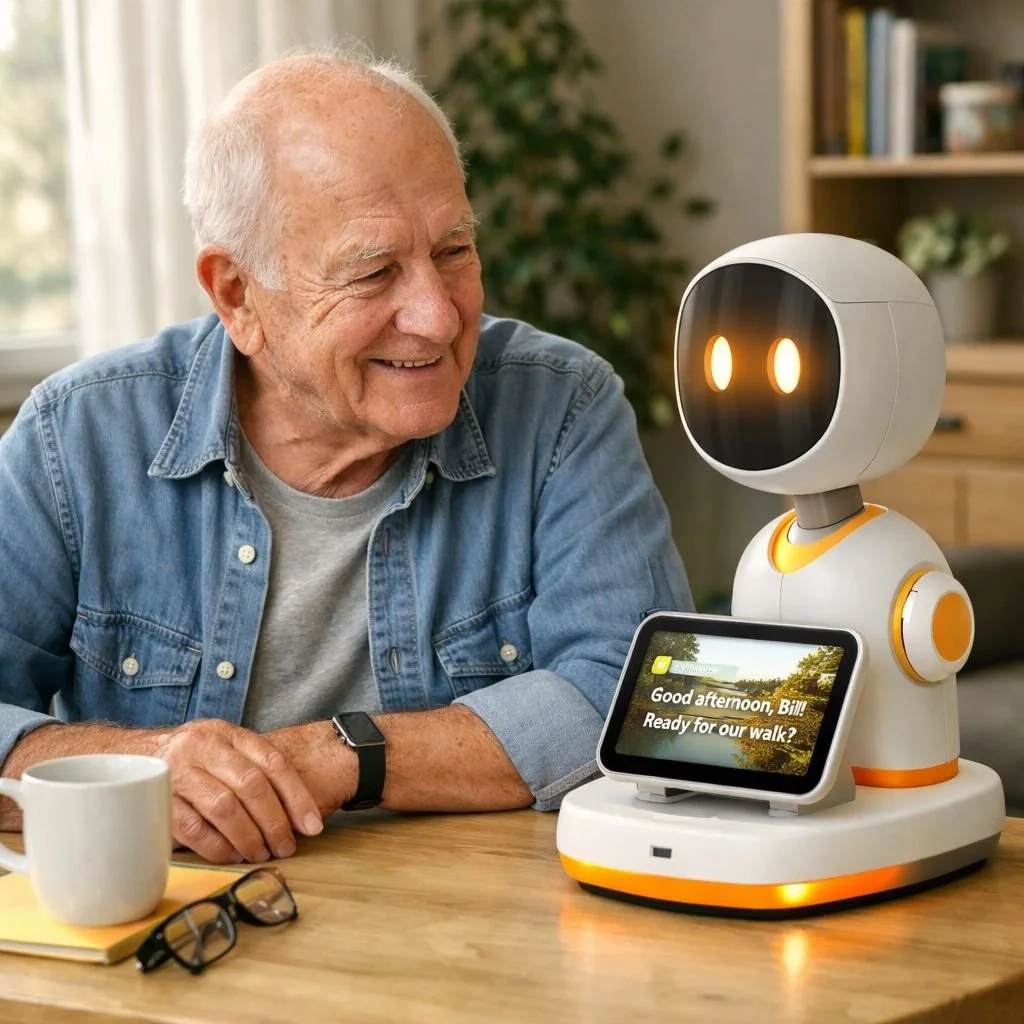
AI companion devices and apps can genuinely ease loneliness for some older adults, particularly those living alone with limited day-to-day contact. The research so far is encouraging but still early. These tools work best as a bridge back to human connection, not a replacement for it.
What is an AI companion, and how is it different to a chatbot?
An AI companion is a device or app built specifically to check in, chat, and keep someone engaged over time. Unlike a chatbot that waits for you to type a question, most companion devices are proactive. They initiate conversation, remember what you've told them, and prompt small daily routines like medication reminders or a stretch break.
Some, like ElliQ, take the form of a small screen-and-light device designed for a tabletop. Others live inside a phone app. All of them are trying to solve the same problem: the quiet stretches of a day when nobody else is around to talk to.
Can talking to an AI companion actually reduce loneliness?
Yes, for some people, and the effect tends to be strongest for older adults living alone with few other social contacts.
A Japanese randomised controlled trial gave a humanoid communication robot to older adults living alone in Tokyo for four weeks (Murayama & Takase, 2025). Participants in the robot group showed measurable improvements in loneliness and psychological wellbeing compared with a control group. A separate meta-analysis pooling eight randomised controlled trials in long-term care facilities found social robot interventions had a significant, sizeable effect on reducing both depression and loneliness, with the strongest results from group-based robot activities (Yen et al., 2024).
A smaller Japanese trial placed conversation robots in the homes of older adults with mild cognitive decline over several months (Figueroa et al., 2023). Participants kept using the robots well beyond the initial novelty period, and the researchers noted the companionship reduced participants' sense of loneliness, though some also became attached enough that removing the robot afterwards caused genuine distress.
Who is likely to benefit most?
The pattern across the research is fairly consistent. AI companions tend to help most when someone:
Lives alone with limited regular contact from family or friends
Has a fairly stable daily routine the device can plug into
Is open to trying new technology, even if unfamiliar with it at first
Still has family or community ties nearby that the device can support rather than substitute for
They're a poorer fit as a stand-alone solution for someone whose loneliness sits alongside untreated depression, anxiety, or grief. In those cases, the device might keep someone company without addressing what's actually driving the distress.
What are the risks and limits?
The research also points to some genuine limits worth naming plainly.
Attachment can run both directions. The Osaka University trial found some participants formed a real bond with their robot, which meant losing access to it afterwards brought its own sadness (Figueroa et al., 2023). A device that becomes a household routine is, in some sense, a relationship, and relationships end.
Family dynamics can shift too. Devices that listen constantly, even to help, can make some family members more guarded around sensitive topics like finances or estate planning when the device is in the room.
And the strongest evidence so far comes from short trials, four weeks in the Japanese RCT (Murayama & Takase, 2025), a few months in the Osaka trial (Figueroa et al., 2023). We don't yet have solid data on what happens over years, or whether the early gains hold up.
Could an AI companion be masking something that needs treatment?
This is worth asking honestly. Loneliness and depression are related but not the same thing, and an AI companion is built to address the first, not diagnose or treat the second.
If low mood, loss of interest, sleep changes, or a sense of hopelessness are sitting underneath the loneliness, a device that provides pleasant daily chat can genuinely help someone feel less alone while the underlying condition goes unaddressed. That's not a reason to avoid these tools. It's a reason to keep an eye on whether things are actually improving, or just feeling occupied.
When is it time to loop in a GP or clinical psychologist?
If loneliness has been sitting alongside low mood, anxiety, grief, or noticeable changes in memory or thinking for more than a couple of weeks, it's worth raising with a GP. This is true whether or not an AI companion is already part of the picture.
A GP can assess whether a Mental Health Treatment Plan and referral to a psychologist would help, alongside anything else going on. For family members supporting a parent or older relative through this, our referral assistance page walks through what that conversation with a GP can look like, and what to expect from a Mental Health Treatment Plan.
What the research tells us
Loneliness carries real health risk. A meta-analysis of 16 cohort studies found loneliness was associated with a 23% higher risk of dementia and a 72% higher risk of Alzheimer's disease specifically (Qiao et al., 2022).
Social robot interventions show a significant, sizeable effect on reducing depression and loneliness in long-term care settings, based on a meta-analysis of eight randomised controlled trials (Yen et al., 2024).
A four-week randomised controlled trial of a companion robot for older adults living alone in Tokyo found measurable improvements in loneliness and wellbeing (Murayama & Takase, 2025).
A preliminary Japanese trial found older adults with mild cognitive decline kept using conversation robots well beyond the novelty period, alongside a reduced sense of loneliness, though some formed attachments strong enough to cause distress when the robot was later removed (Figueroa et al., 2023).
The company behind ElliQ reports the device has been deployed by fifteen US government agencies and describes early engagement and quality-of-life findings as promising, though this comes from an industry-linked publication rather than an independent trial (Broadbent et al., 2024).
Frequently asked questions
Is loneliness itself a mental health condition?
No. Loneliness is a subjective feeling, the gap between the social connection you have and the connection you'd like. It's strongly linked to depression, anxiety, and dementia risk, but it isn't a diagnosis on its own.
Can an AI companion replace therapy or a Mental Health Treatment Plan?
No. These devices are built for company and routine, not assessment or treatment of a mental health condition. If depression, anxiety, trauma, or another diagnosable condition is present, a psychologist working from a GP referral is the appropriate next step.
Is it safe to share personal information with these devices?
Worth checking the privacy policy of whichever device or app you're considering, since they vary. Most proactive companion devices work by listening and remembering details over time, which is exactly what makes them useful and exactly why it's reasonable to ask questions before bringing one into your home.
My parent has started relying on an AI companion. Should I be concerned?
Not necessarily. For many older adults living alone, this kind of device fills genuinely empty hours. It's worth a gentle conversation if it seems to be replacing contact with you or others, rather than sitting alongside it.
Not sure whether what you're noticing in yourself, or in someone you love, is loneliness, low mood, or something else. That's a completely reasonable thing to bring to a GP. Our referral assistance page explains how a GP referral and Mental Health Treatment Plan work, and what a first session with us looks like. Book a free 20 minute consultation to discuss your therapy needs.
References and reading
Broadbent, E., Loveys, K., Ilan, G., Chen, G., Chilukuri, M. M., Boardman, S. G., Doraiswamy, P. M., & Skuler, D. (2024). ElliQ, an AI-driven social robot to alleviate loneliness: Progress and lessons learned. The Journal of Aging Research & Lifestyle, 13, 22–28. https://doi.org/10.14283/jarlife.2024.2
Figueroa, D., Yamazaki, R., Nishio, S., Maalouly, E., Nagata, Y., Satake, Y., Yamakawa, M., Suzuki, M., Kanemoto, H., Ikeda, M., & Ishiguro, H. (2023). Social robot for older adults with cognitive decline: A preliminary trial. Frontiers in Robotics and AI, 10, Article 1213705. https://doi.org/10.3389/frobt.2023.1213705
Murayama, H., & Takase, M. (2025). Evaluating the effectiveness of digital social robots in reducing loneliness among community-dwelling older adults in Japan: Randomized controlled trial and qualitative analysis. JMIR Aging, 8, Article e74422. https://doi.org/10.2196/74422
Qiao, L., Wang, G., Tang, Z., Zhou, S., Min, J., Yin, M., & Li, M. (2022). Association between loneliness and dementia risk: A systematic review and meta-analysis of cohort studies. Frontiers in Human Neuroscience, 16, Article 899814. https://doi.org/10.3389/fnhum.2022.899814
Yen, H.-Y., Huang, C. W., Chiu, H.-L., & Jin, G. (2024). The effect of social robots on depression and loneliness for older residents in long-term care facilities: A meta-analysis of randomized controlled trials. Journal of the American Medical Directors Association, 25(6), Article 104979. https://doi.org/10.1016/j.jamda.2024.02.017
